Every healthcare center knows the feeling. A Tuesday afternoon with three empty chairs, a schedule that looked full on Friday, and a front desk team that did everything right — sent the reminder, confirmed the appointment, updated the chart. And still, the patients didn't show.
Missed visits and appointment adherence aren't fringe problems. Across healthcare settings, no-show rates average between 18% and 30% depending on specialty and patient population. In community health centers, the numbers can run even higher. And behind every empty slot is a real cost: lost clinical capacity, disrupted care continuity, and revenue that can't be recovered once the hour passes.
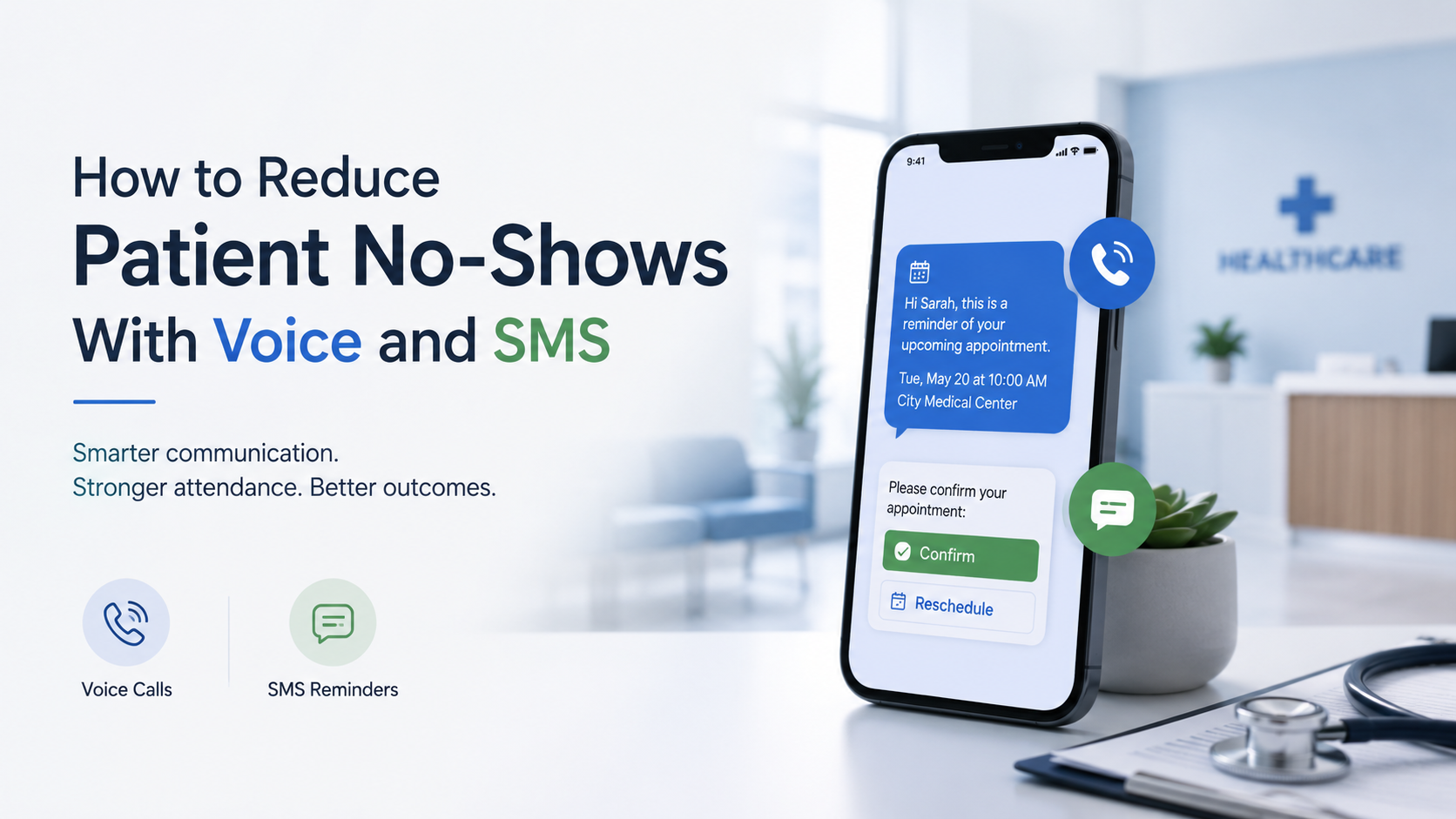
The good news is that most no-shows are preventable. Not with more staff, and not with friction-heavy policies — but with a smarter, more consistent communication strategy built around the two channels patients actually respond to: voice and SMS.
Why Single-Channel Reminders Keep Failing
Most practices default to one reminder method — usually an automated text sent 24 hours before the appointment. It's better than nothing. But it has a fundamental limitation: it assumes every patient behaves the same way.
Some patients read every text within minutes. Others have notifications turned off, ignore unknown numbers, or simply don't process a reminder that arrives while they're distracted. A single touchpoint, delivered once, through one channel, is a bet — and it's one your practice loses a significant percentage of the time.
Patient follow-up works best when it meets people where they are, in the format that reaches them. For some patients, that's a text they can reply to at their convenience. For others, it's a voice call that creates a moment of real engagement and makes ignoring the appointment feel less passive.
The practices that have moved the needle on no-show reduction have stopped choosing between the two — and started using both, intentionally.
Build a Multi-Touch Confirmation Sequence
The most effective no-show reduction strategy in healthcare isn't a single reminder. It's a structured sequence with multiple touchpoints timed around the appointment.
A practical structure looks like this:
72 hours out:
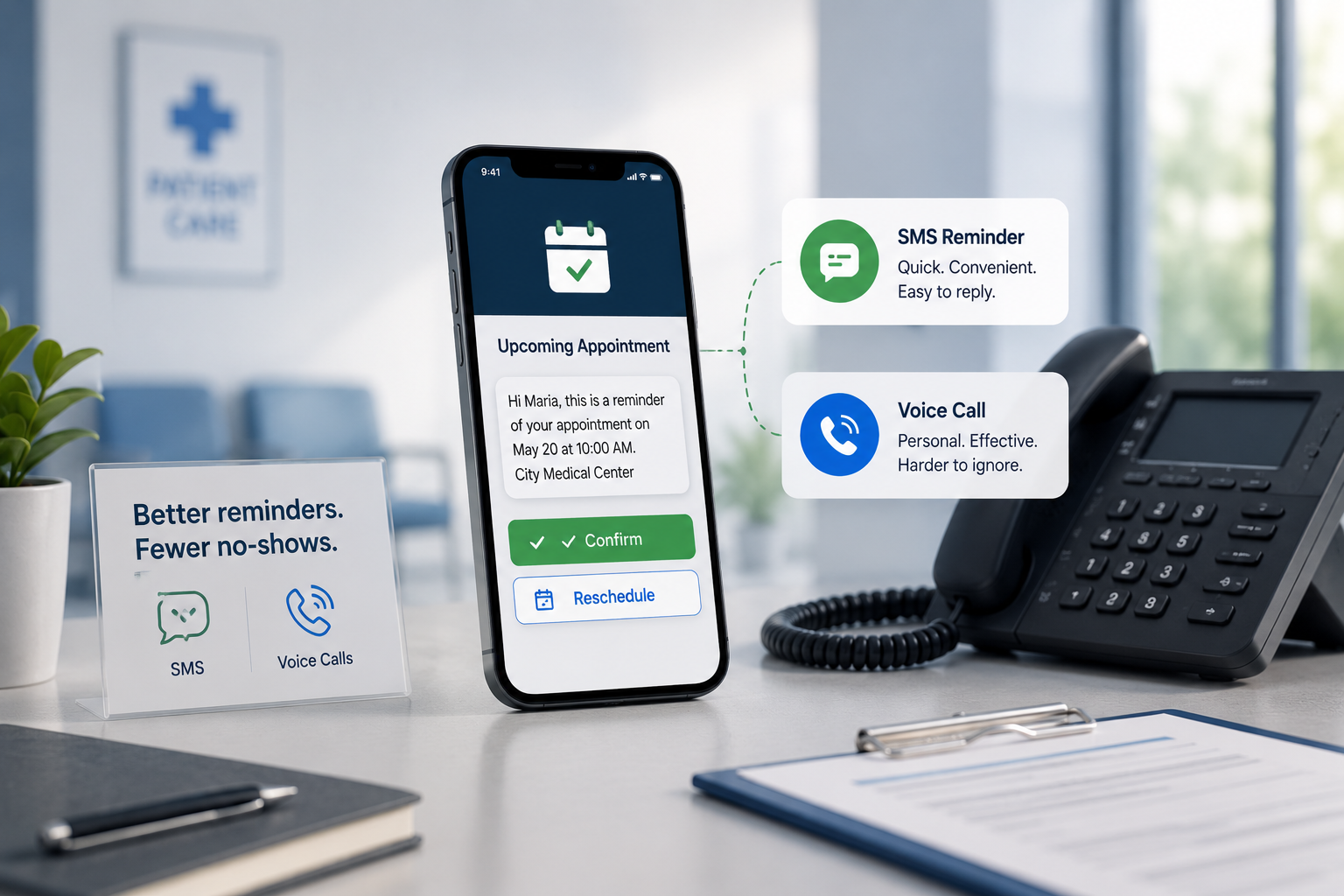
SMS confirmation request — short, direct, with a one-tap confirm or reschedule option
48 hours out:
Outbound voice call for patients who haven't confirmed — warm, professional, asks the patient to confirm or flags a need to reschedule
24 hours out:
Final SMS reminder for confirmed patients — brief, with location details and any prep instructions
Same morning:
Optional voice call for high-risk appointments (new patients, long-gap returners, complex procedures)
Each touchpoint serves a different function. The early SMS filters your easy confirmations quickly. The 48-hour voice call reaches the undecided patient — the one who's been meaning to confirm but hasn't, or the one who's quietly reconsidering. The final reminder removes last-minute logistical friction.
Together, they create a patient follow-up rhythm that feels attentive, not aggressive — and that catches the no-show before it happens rather than reacting after.
Why Voice Outperforms SMS for At-Risk Patients
For routine confirmations, SMS is efficient and sufficient. But for patients most likely to miss appointments — those with chronic conditions, complex social circumstances, long gaps since their last visit, or a history of missed visits — voice is meaningfully more effective.
A phone call creates accountability that a text doesn't. It's harder to passively ignore. It opens a real-time exchange where a patient can flag a barrier — transport issues, a schedule conflict, confusion about the appointment — that a text reply would never surface.
Healthcare centers that add outbound voice calls to their reminder workflow report no-show reductions of up to 30% compared to SMS-only approaches. The calls don't need to be long. A 90-second call that confirms the appointment, asks if the patient has any questions, and offers an easy path to reschedule if needed does the job.
The barrier for most practices isn't knowing that voice works — it's finding the capacity to make those calls consistently. Which is where the conversation about automation becomes practical.
Automate the Workflow Without Losing the Human Feel
Manual outbound calling at scale isn't realistic for most clinical teams. A practice managing 150 appointments per week would need several hours of dedicated phone time daily — time that doesn't exist when the team is managing check-ins, insurance verification, and in-room patient care simultaneously.
AI voice agents change that equation. A well-designed outbound AI caller can handle confirmation calls with natural, conversational language — not robotic scripts — while your team focuses on patients already in the building.
The key is that the automation needs to feel personal, not automated. That means using the patient's name, referencing the specific appointment type, and giving the patient a genuine opportunity to respond — not just a one-way broadcast dressed up as a call.
When that standard is met, patients don't experience the call as impersonal. They experience it as a practice that follows up — which, compared to the alternative, is already a meaningful differentiator in how patients perceive their care.
Close the Loop: What Happens After a Missed Visit
Even with a strong confirmation sequence, some patients will miss appointments. What you do in the next 24 hours determines whether that's a permanent loss or a recoverable one.
A same-day or next-morning outreach call — framed around the patient's wellbeing rather than the scheduling gap — has a significantly higher rebooking rate than a generic reschedule link sent days later. The message doesn't need to be complex: we noticed you weren't able to make it in, we want to make sure you're okay, and we'd love to find you another time that works.
That call closes the appointment adherence loop. It signals that your practice tracks who came in and who didn't — and that patients aren't just a number in a scheduling system. For patients managing chronic conditions or ongoing treatment plans, that signal matters. It's often the difference between a patient who re-engages and one who quietly disappears from your panel.
The System That Runs Without You Thinking About It
Reducing missed visits at scale requires consistency that manual processes can't deliver. Staff get busy. Follow-ups get deprioritised. High-risk patients who most need outreach are the hardest to reach and the easiest to let slip.
A voice and SMS workflow that runs automatically — confirmation sequences, outbound calls for unconfirmed patients, same-day recovery outreach for no-shows — removes the dependency on your team remembering to do it. The system runs. The appointments fill. The no-show rate comes down.
That's not a staffing solution. It's an infrastructure one. And it's the reason healthcare centers that build it consistently outperform those that don't on appointment adherence metrics quarter after quarter.
See how Everguide builds this workflow for healthcare practices — book a demo at everguide.io