You're spending real money to get your phone ringing. Google Ads, Meta campaigns, influencer partnerships, monthly retainers to an agency that sends you a report you half-read. For most medspas, that number sits somewhere between $3,000 and $10,000 per month.
And yet the books still aren't full.
The instinct is to blame the marketing. Change the creative. Adjust the targeting. Try a new platform. But before you move a dollar of budget, there's a question worth answering honestly: what happens when those campaigns actually work. When a prospect picks up their phone and calls you?
Because if that call goes unanswered, you didn't have a marketing problem. You had a conversion problem. And no amount of ad spend fixes that.
The Real Cost of a Missed Call
Here's the number that reframes this entire conversation: medspa marketing ROI and patient acquisition costs are only meaningful if the leads you generate actually convert.
If your cost to acquire a new medspa client — factoring in ad spend, creative, and agency fees — runs $150 to $300 per booked patient, then every missed call isn't a minor inconvenience. It's $150 to $300 in marketing spend handed directly to whoever answered their phone next.
That's not hyperbole. A prospect who calls a medspa is motivated. They've seen your ad, clicked through, made a decision, and reached for their phone. That's as warm as a lead gets. When they hit voicemail, they don't wait — they call the next result on Google. Your competitor just got a new patient and you paid for the acquisition.
Do that ten times a week across a busy campaign period, and you're looking at $1,500 to $3,000 in wasted acquisition spend — every week — that doesn't show up anywhere in your marketing dashboard.
Why Your CAC Is Lying to You
Customer acquisition cost is one of those metrics that looks clean on a spreadsheet and hides a mess underneath.
Most medspas calculate CAC by dividing total marketing spend by the number of new patients booked. Tidy. But that calculation assumes every lead your campaigns generated had a fair chance of converting. It doesn't account for the calls that went to voicemail, the web inquiries that never got followed up, the DMs that sat in a inbox for three days before anyone responded.
Your real CAC — the cost per lead your practice actually captured — is significantly higher than the number you're reporting. And if your answer rate during peak hours or after hours is poor, the gap between those two figures could be substantial.
This matters because unit economics in the medspa space are already under pressure. Treatments are competitive. Clients have options. If your acquisition cost is inflated by a conversion leak you haven't diagnosed, the margin math gets uncomfortable fast.
The Conversion Layer Most Medspas Don't Have
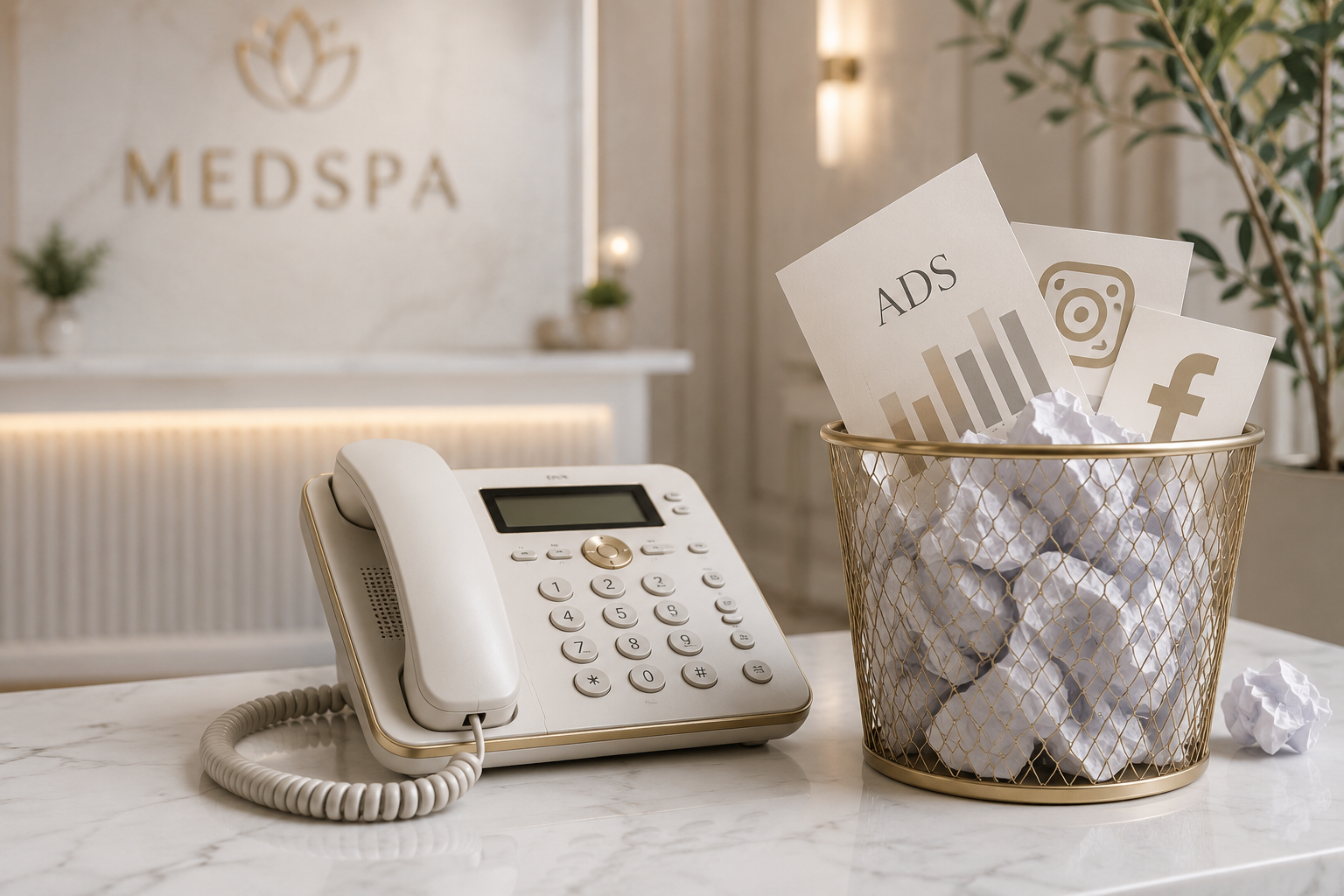
Marketing generates interest. Conversion captures it. Most medspas invest heavily in the first and almost nothing in the second.
A functional conversion layer for a medspa looks like this: every inbound call answered, every web or social inquiry followed up within the hour, every cancellation met with a same-day recovery call, every no-show followed by a re-engagement outreach within 24 hours. That's not a marketing function — it's an operational one. And it's the part of the acquisition funnel that most practices leave entirely to chance.
Consider the typical Monday morning: three patients checking in, two calls coming in simultaneously, a front desk coordinator managing all of it. Something gives. It's always the phone.
The leads your marketing just generated — the ones you paid for — go to voicemail. The campaign keeps running. The spend keeps accumulating. The conversion rate stays flat. And the agency gets asked to refresh the creative.
The Math That Makes the Case
Run this for your own practice. Take your monthly ad spend, divide it by your actual booked new patients for the month, and write down that number. Then estimate how many inbound calls or inquiries you received that didn't convert — calls that went unanswered, leads that weren't followed up, cancellations that were never recovered.
Assign your average treatment value to those lost opportunities. Then ask: what would a 20% improvement in conversion rate be worth, with zero additional spend?
For a practice spending $5,000 a month on ads and booking 30 new patients, a 20% conversion improvement means six additional patients per month. At an average first-visit value of $400, that's $2,400 in revenue — nearly half the ad budget — recovered not by spending more, but by answering the phone.
Lower your effective CAC. Increase your retained client base. The unit economics shift significantly without a single change to your campaigns.
Fix the Leak Before You Turn Up the Tap
More ad spend into a leaking funnel doesn't fix the leak. It just makes the waste more expensive.
The practices with the strongest medspa marketing ROI aren't necessarily running better campaigns than their competitors. They've built a conversion layer that captures what their marketing generates — every call answered, every lead followed up, every cancellation given a real chance at recovery.
That's the operational fix. And it doesn't require new hires or a process overhaul — it requires a system that runs consistently regardless of how busy your team is.
See how Everguide closes the conversion gap — try the demo at everguide.io