Most healthcare centers are already sending reminders. The problem isn't that patients aren't being reminded — it's that the reminder lands at the wrong time, through the wrong channel, without a follow-up when there's no response.
Appointment adherence doesn't improve because you remind patients. It improves because you remind them well — with the right message, at the right moment, in a sequence that accounts for the fact that people are busy, distracted, and sometimes quietly reconsidering whether they'll show up.
A well-built reminder cadence isn't complicated. But it's specific. And most practices aren't running it.
Why Timing Is the Variable Most Practices Get Wrong
Send a reminder too early and the patient acknowledges it, intends to show up, and then forgets entirely by appointment day. Send it too late and you've given them no time to reschedule if something's come up — which means they simply don't come in.
The instinct for most healthcare centers is to send one reminder, 24 hours out, via text. It's automated, it's easy to set up, and it feels sufficient. But a single touchpoint the day before captures only the patients who were already planning to come. It doesn't reach the undecided patient. It doesn't address barriers. It doesn't give your team time to fill a slot if someone cancels.
The math on this matters: if your no-show rate is 20% across 200 monthly appointments, that's 40 missed visits. Shifting that rate to 12% — a realistic outcome with a structured cadence — recovers 16 appointments per month. At an average visit value of $200, that's $3,200 in revenue that was already scheduled and simply needed a better follow-up system to materialise.
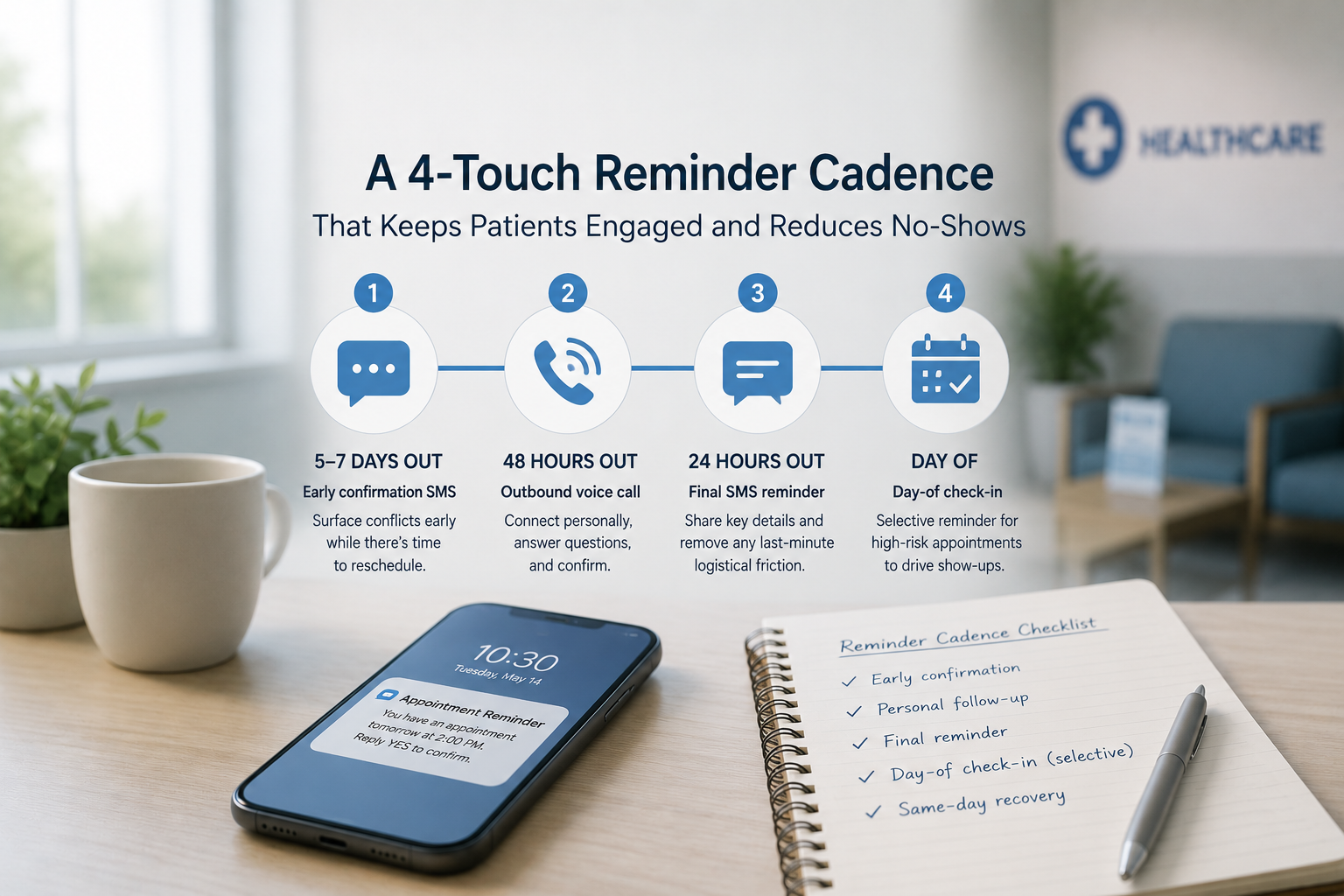
The Four-Touch Cadence Built for Healthcare Centers
This is the structure. Each touchpoint has a purpose — remove any one of them and you create a gap that no-shows slip through.
Touch 1 — 5 to 7 Days Out: The Early Confirmation SMS
A brief, friendly text that confirms the appointment details and gives the patient a simple way to confirm or flag a conflict early. The goal here isn't urgency — it's surfacing problems while you still have time to act on them.
"Hi [Name], this is a reminder that you have an appointment with [Practice] on [Day] at [Time]. Reply YES to confirm or call us to reschedule."
Patients who can't make it will tell you now, when you have a full week to fill the slot. That's the value of this touchpoint — it's an early warning system, not just a reminder.
Touch 2 — 48 Hours Out: The Outbound Voice Call
This is the most important touchpoint in the sequence — and the one most practices skip because it requires actual phone time.
An outbound call 48 hours before the appointment reaches patients who haven't engaged with the SMS, surfaces last-minute concerns, and creates a real moment of connection that a text message simply can't replicate. Patient follow-up via voice at the 48-hour mark has been shown to reduce missed visits by up to 30% compared to SMS-only approaches — because a phone call creates a response in a way that a notification doesn't.
The call doesn't need to be long. Sixty to ninety seconds: confirm the appointment, ask if they have any questions or need to make changes, and close warmly. That's it.
Touch 3 — 24 Hours Out: The Final SMS Reminder
By now, you've filtered the easy confirmations and reached the undecided patients by voice. The 24-hour SMS is for confirmed patients — a brief, logistical message with timing, location, and any prep instructions specific to their visit type.
Keep this one short. The patient is confirmed. They don't need another sales pitch on why they should show up — they just need a clean, frictionless reminder that removes any last-minute logistical confusion.
Touch 4 — Morning of the Appointment: The Day-Of Check-In (Selective)
This isn't for every appointment. Reserve the morning-of call or text for three specific patient groups: new patients attending their first visit, patients with a history of missed visits, and patients scheduled for procedures requiring prep or fasting.
For these patients, a brief morning check-in — "Just a reminder you're scheduled with us at 2 p.m. today, we'll see you soon" — dramatically reduces same-day no-shows. It also gives patients a final window to flag a genuine conflict before the slot is wasted.
What to Do When a Patient Doesn't Respond
A patient who goes through your entire reminder sequence without confirming is a patient at high risk of not showing up. Most practices wait to find out. A smarter approach is to treat non-response as a signal and act on it.
If a patient hasn't responded after Touch 2, a brief outbound call from your team — or an AI agent — before the 24-hour mark asking directly: "We haven't been able to confirm your appointment for tomorrow — are you still planning to come in, or would you like to reschedule?" converts a meaningful percentage of at-risk appointments into either confirmed visits or early cancellations you can fill.
Silence isn't neutrality in appointment adherence. It's a warning sign. Treating it as one is the difference between a proactive system and a reactive one.
The No-Show Recovery Step Most Cadences Leave Out
Even the best reminder cadence won't eliminate missed visits entirely. What separates high-performing healthcare centers from average ones is what happens after a no-show occurs.
A same-day recovery call — within two to four hours of the missed appointment — should be a standard part of every cadence. Frame it around the patient, not the slot:
"We noticed you weren't able to make it in today and wanted to check in. We'd love to find a time that works better for you."
That framing matters. It signals care rather than inconvenience, and it opens the door to a rebook before the patient's momentum to seek care fades entirely. Patients who receive a same-day recovery call are significantly more likely to rebook within the week than those who receive a generic reschedule link days later.
Why Consistency Is the Only Thing That Makes a Cadence Work
The logic of a four-touch reminder sequence isn't complicated. Most practice managers, when they see it mapped out, agree it makes sense. The failure point is almost never the strategy — it's the execution.
Manual follow-up at this level requires hours of dedicated outreach time per week. On a busy clinical day, it's the first thing that gets deprioritised. One day it slips, then two, then the cadence becomes a rough guideline rather than a system.
Appointment adherence improves when the cadence runs every day, for every patient, without depending on your team's bandwidth to make it happen. That's the case for automation — not to replace the human judgment your team brings to complex patient interactions, but to make the repeatable, high-volume communication layer consistent in a way that manual processes never will be.
AI voice agents and automated SMS workflows handle the cadence. Your team handles the patients. Both work better as a result.
See how Everguide builds this cadence for healthcare centers — book a demo at everguide.io